
Best Time to See Larches in Washington: 8 Years of Trail Report Data

Every fall, hikers across Washington start asking the same question: when will the larches turn gold?
Unlike most of Washington’s evergreen forests, larches are deciduous conifers. They grow needles in the spring, stay green through the summer, then gradually lose their chlorophyll as temperatures cool and daylight shortens. For a brief stretch each fall, their needles turn from green to yellow and eventually a brilliant gold before dropping for winter.
That transformation is what makes larch season one of our favorite times of year to hike in Washington. Entire alpine basins that were green just a few weeks earlier suddenly glow yellow against granite peaks, blue lakes, and if you time it right an early dusting of snow.
The difficult part is figuring out when to go.
You’ll often hear that the first or second week of October is the best time to see Washington’s larches. That’s generally good advice, but after years of planning our own fall hikes, we wanted to know how reliable that window actually is.
So we went looking for data.
How We Determined Peak Larch Season
For this analysis, we reviewed eight years of fall trail reports, mostly from the WTA as there are more pictures and typically more detailed reports, with some help from alltrails when there were date gaps, from 2018 through 2025, for three of Washington’s best-known larch destinations:
Cutthroat Pass
Lake Ingalls
The Enchantments
Rather than relying only on the date of a trip report, we reviewed the descriptions and, where possible, the photographs associated with each report to determine the condition of the larches and if they matched the report.
We grouped observations into several stages:
No color → First color → Early color → Almost peak → Peak → Past peak
That allowed us to follow the progression of the larches through an entire fall season rather than simply choosing one report each year and calling it “peak.”
We also noted the final meaningful fall reports, including significant snow events, because the practical hiking season can sometimes end shortly after the larches reach their best color.
There is still some subjectivity involved as one hikers “peak” may be another hikers “almost peak” but looking at multiple reports and photographs from the same season helped us narrow those transitions considerably.
A Note About Subalpine vs. Western Larches
Most of the hikes in this analysis feature subalpine larch (Larix lyallii), the species responsible for many of Washington’s most dramatic alpine larch displays.
Subalpine larches thrive in harsh, high-elevation environments near treeline. They are especially common in places like the eastern North Cascades, the Teanaway, and the Enchantments, where golden trees stand among granite peaks and alpine lakes.
Washington also has western larch (Larix occidentalis), which generally grows at lower elevations and can form much larger trees and forests.
Because western larches grow lower on the mountains, and often experience warmer fall temperatures, their color can lag behind the highest subalpine larches, meaning larch season does not necessarily happen everywhere in Washington at exactly the same time.
For this particular analysis, however, we intentionally focused primarily on subalpine larch hikes.
Part of the reason is consistency: comparing similar high-elevation environments gives us a better idea of how peak timing changes from year to year.
The other reason is admittedly less scientific:
Subalpine larches tend to grow in some ridiculously beautiful places.
So while the dates below shouldn't necessarily be applied directly to every western larch forest in the state, they provide a very useful benchmark for planning Washington's classic high-elevation larch hikes.
So, What Is the Best Time to See Larches in Washington?

After comparing the data from all three locations, one date range was most consistent:
October 7–10
If we were planning a Washington larch trip months in advance and wanted to see larches at there absolute peak this would be the most likely range.
But there was also meaningful variation.
Some years brought peak color as early as the first few days of October, while particularly late seasons pushed the best color toward the middle of the month.
And perhaps the most interesting finding was that the three hiking areas often moved together.
When larches were late at Cutthroat Pass, they tended to be late at Lake Ingalls and the Enchantments too. When one location peaked early, the others often followed a similar pattern.
That suggests that the weather in a given year may matter more than choosing between these three individual hikes.
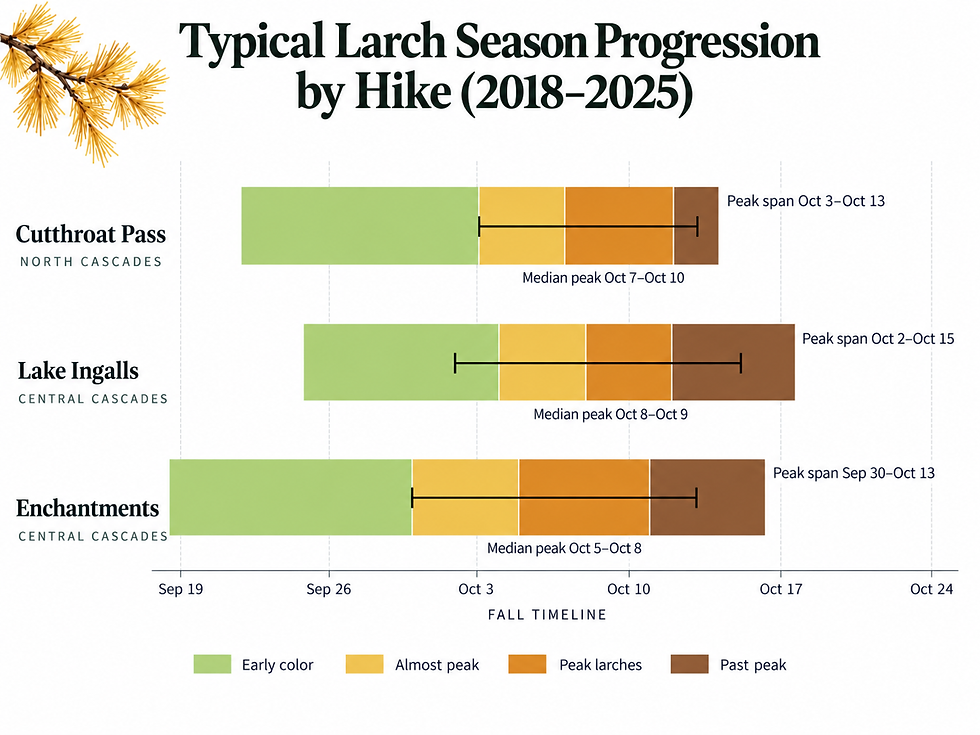
If We Had to Pick One Day: October 7
If we were planning a Washington larch trip months in advance and had to choose one date, we would pick October 7.
Across the eight years of data we reviewed, October 7 consistently falls within, or very close to, peak conditions at Cutthroat Pass, Lake Ingalls, and the Enchantments. You may occasionally be a few days early, but you are very likely to see excellent color.
There is also a practical reason we would choose October 7 instead of waiting another week: the risk of early winter weather starts increasing quickly as you move deeper into October. In several years we reviewed, snow arrived shortly after peak color, trail conditions became substantially more difficult, or fall trip reports stopped altogether.
So while October 10–12 may occasionally produce slightly deeper gold, we think October 7 offers the best balance between larch color and your odds of still having good hiking conditions.
Our pick: Plan around October 7, then adjust a few days earlier or later if current trail reports and weather allow.

Peak Larch Timing by Year: 2018–2025 Takeaways
Looking at each year individually shows just how much larch season can shift.
2019, 2022, and 2024 were relatively late seasons, with peak conditions frequently landing around October 10–13.
By comparison, 2020 and 2021 peaked much earlier, with several locations showing excellent color during the first week of October.
Across the three areas we studied, the Enchantments tended to peak the earliest, on average a couple of days ahead of Lake Ingalls and Cutthroat Pass. The Enchantments also showed the widest range of peak dates, which is likely at least partly explained by the much greater range of elevations and basins included in Enchantments trip reports. In some years, the first signs of color appeared as early as mid-September, and strong color could persist longer than at the other two locations.
Lake Ingalls and Cutthroat Pass were much more similar in their timing. Both generally moved into early color during the final week of September and reached their strongest color during the first third of October. Cutthroat Pass, however, appeared to have a slightly shorter practical fall hiking window. In several years, the final trail report came only a few days after peak color as snow arrived and conditions became more difficult.
One thing that stood out in the trail reports was how quickly larch season can end. Several hikers described strong winds or early snowstorms stripping needles from the trees in a very short period. A location that looked near perfect one weekend could be noticeably past peak only a few days later.
The last week of September is generally still early larch season across all three areas. You can expect plenty of green mixed with yellow at that point, although there were exceptions: in some years, all three regions had already reached almost-peak conditions by around October 1.
By contrast, the window begins closing quickly after the middle of October. In most of the years we reviewed, all three areas were already past peak by October 15, and snow or deteriorating trail conditions were becoming increasingly common.
Taken together, the data reinforces why we like October 7 as the best date to plan around. It gives you an excellent chance of seeing peak or near-peak larches across all three regions, while still giving you a little more margin before the increasingly unpredictable snow, wind, and winter conditions of mid-October.

If you are interested in exploring more Washington Trails take a look at our new ranked and sortable list of our best hikes by clicking the image below:

For an in depth trail report of a famous hike near Cutthroat pass check out our post on Maple Pass Loop and Lewis Lake which we did in almost peak conditions.
Keep Exploring With Us
Are you a serious hiker and planning a trip to Washington?
Check out our Ultimate 7-Day Washington Hiking Road Trip for Serious Day Hikers.
Our 20 Favorite Mount Rainier Hikes
We have hiked all over Mount Rainier. See our firsthand rankings of 20 of our favorite trails in and around the park.
The Perfect 3-Day Mount Baker Getaway
Ready to explore another part of Washington? See how we would spend three days hiking around Mount Baker.
Our Pacific Northwest Bucket List
Looking for even more adventures? Check out our list of places we have loved — and a few we still need to wander to.
Wandering Bear Cabin
Stay just outside Mount Rainier National Park and come back to a cozy cabin after a long day outside.
Owl's Outpost
Another one of our favorite home bases for exploring Mount Rainier.


Comments