
Seven Lakes Basin & High Divide Loop Backpacking Guide (2026)
Updated: Aug 30
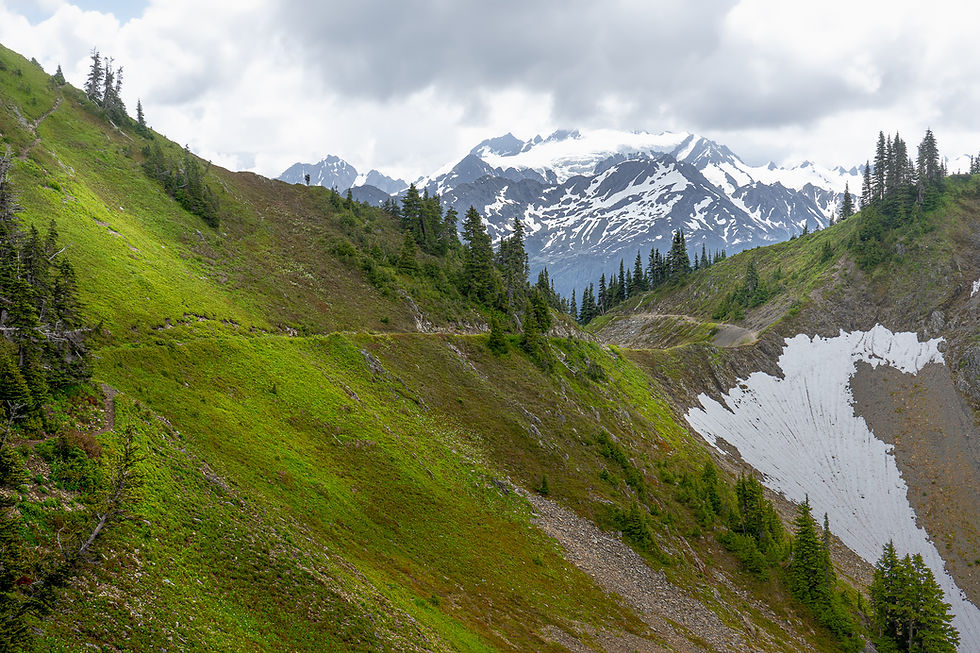
The Seven Lakes Basin and High Divide Loop is one of the premier backpacking trips on the Olympic Peninsula and one of our favorite hikes in Washington. Along the way, you’ll pass through lush river valleys, camp beside alpine lakes, have great mountain views, cross wildflower-filled meadows, and have plenty of opportunities to spot wildlife. It’s also one of Olympic National Park’s most popular backpacking routes, so permits and campsites require some advance planning. We’ve backpacked this trail twice, and both trips have only reinforced why we consider it one of the best backpacking experiences in Washington.
Seven Lakes Basin Quick Facts
Miles | 19.2 |
Elevation | 4050 ft |
Difficulty | Moderate to Strenuous |
Time | 2-4 days |
Trailhead | Sol Duc Falls |
Best Season | Mid July - Late September |
Permit | Required for all overnight trips |
Bear Canister | Required |
Best Camps | Round Lake, Lunch Lake, Heart Lake |

How to Get a Seven Lakes Basin Permit
A wilderness camping permit is required for all overnight trips in the Seven Lakes Basin and High Divide area. This is one of the most popular backpacking routes in Olympic National Park, and campsites can fill months in advance, so we highly recommend planning ahead.
Reserving a Permit
Permits are reserved through Recreation.gov. For the 2026 season, Olympic National Park releases summer wilderness permit reservations on April 15 at 7:00 AM Pacific Time for trips between July 15 and October 15.
Seven Lakes Basin has a shorter practical backpacking season because snow can linger into July. If you’re hoping to hike during peak summer, we recommend being ready to book as soon as reservations become available.
When making your reservation, you’ll select the designated campsites where you plan to spend each night. Popular sites such as Lunch Lake, Round Lake, Heart Lake, Deer Lake, and Sol Duc Park can fill quickly.
Missed the Initial Permit Release?
If you miss the initial reservation window, don’t assume your trip is over. Cancellations do happen, and when someone gives up a reservation, that campsite can become available again on Recreation.gov.
We’ve found that a little luck and persistence can pay off. Check Recreation.gov regularly especially as your preferred dates get closer and be ready to book quickly if an opening appears. Reservations get full refunds 3 days prior to their trip so sometimes there is a bit more turnover about 3-7 days before the date you are looking for.
If possible, have a few alternate itineraries in mind. For example, if Lunch Lake is unavailable, you may be able to build a route around Deer Lake, Hoh Lake, or Lower Bridge instead.
Can You Get a Walk-Up Permit?
These are no longer available. There are alternative routes near Seven Lakes Basin during peak season including into Cat Basin or around Morgenroth Lake which you can inquire with the WIC center.
If you are trying to plan a last-minute trip or travel outside the normal reservation window, contact the Olympic National Park Wilderness Information Center to ask about current availability and permit options. Rules and availability can change, so we recommend checking directly with the park before making the drive.
Other Important Permit Rules
Camping is allowed only at designated campsites in the Seven Lakes Basin/High Divide area.
Groups of 7–12 people must stay in designated group campsites.
A park-approved bear canister is required for food, garbage, and scented items throughout the loop.
Snow commonly remains on portions of the High Divide into early or mid-July. Early-season travel can involve steep snow and may require an ice axe, self-arrest skills, and other appropriate snow-travel equipment. We have hiked as early as July 4th in low snow years.
You will also need to pay the applicable Olympic National Park entrance fee or have a valid federal recreation pass when entering the park.
Our advice: If Seven Lakes Basin is the main reason for your trip, reserve your campsites as early as possible. If you miss the initial release, keep checking - cancellations can create opportunities, and flexibility plus persistence can sometimes get you onto the trail.
Our Verdict After Hiking It Twice
The Seven Lakes Basin and High Divide Loop is an amazing backpacking trip that is well worth the effort. Our overall rating for this hike is an impressive 92/100, placing it #4 on our list of the best hikes in the Pacific Northwest.

One thing we learned after hiking it twice is that your campsite can have a big impact on the overall experience. If possible, we highly recommend securing an alpine or lakeside campsite—waking up beside one of the lakes or high in the mountains makes an already spectacular trip even more memorable.
We’ve backpacked the loop during two very different parts of the season. Our first trip was during the first week of July in a year with an unusually low snowpack. The landscape was incredibly green, wildflowers were abundant, and streams were flowing strongly, but the mosquitoes were also much worse. On our second trip in mid-August, conditions were noticeably drier, but the scenery was still beautiful and we saw considerably more wildlife—including several bears feeding on ripe berries.
If we had to choose between the two, mid- to late summer would be our preference for fewer bugs and better wildlife viewing, while early season can be especially beautiful if snow conditions allow. Conditions vary significantly from year to year, so always check current trail and snow conditions before your trip.
Should I hike Seven Lake Basin Clockwise or Counterclockwise
You can hike the loop in either direction, with the route splitting near Sol Duc Falls. Our recommendation is to hike counterclockwise. This direction is steeper and rockier, but you reach the subalpine terrain and big mountain views much sooner, which we think makes for a more rewarding start to the trip.
Going clockwise offers a more gradual climb, but much of the early route passes through a long forested section before reaching the higher-elevation scenery.
TRAIL DETAILS and Route Breakdown

Sol Duc Falls to Deer Lake — About 3 Miles
From Sol Duc Falls, the trail climbs roughly 3 miles through the classic lush, dense forest that Olympic National Park is known for. You will still encounter some day hikers and backpackers heading toward Deer Lake, but the large crowds around Sol Duc Falls quickly begin to disappear.
The trail is rocky and fairly steep in places, but it remains shaded almost the entire way—a welcome benefit on hot summer days. Eventually, you emerge at Deer Lake, a peaceful, mostly forested lake surrounded by trees with plent of campsites.
Deer Lake is a great place to stop for lunch, and it also makes a good first-night campsite if you are planning a three-night trip or getting a later start. We stayed here on our second Seven Lakes Basin trip and found several excellent, secluded campsites.
Deer Lake to the Seven Lakes Basin Junction — About 3.2 Miles

From Deer Lake, the trail continues climbing for another 3.2 miles through subalpine forest toward the Seven Lakes Basin and High Divide junction. This is where the scenery really starts to open up, with your first mountain views and several small lakes along the route.
Despite hiking this section on a summer Saturday, we saw only four other people, making it feel surprisingly quiet.
Before reaching the Lunch Lake turnoff, the trail crosses a short area affected by geologic activity. This section can be rough and uneven, although conditions had improved considerably when we repeated the hike in 2026 as the route became more established.
Seven Lakes Basin Junction to Lunch Lake — About 0.8 Miles
At roughly 7.2 miles, you will reach a signed junction. Seven Lakes Basin and Lunch Lake are to the left, while the High Divide continues to the right.
If you are heading to Lunch Lake, take the trail to the left. The lake is about 0.8 miles from the junction. We met several hikers who accidentally missed this turn, so it is worth paying attention here.
Even if you are not camping at Lunch Lake, we highly recommend making the detour. The basin is one of the most beautiful parts of the entire trip and is well worth the extra mileage.

As you descend into the basin, you will see Round Lake on the left and Lunch Lake on the right. In our opinion, these are some of the best campsites on the entire loop—and unsurprisingly, some of the hardest permits to secure.
We stayed at a secluded site near the end of Round Lake that remains one of our favorite campsites anywhere. Wildlife is abundant in this area. We saw several bears, including one swimming in Lunch Lake, along with numerous deer wandering through the basin and around our campsite.
Because bears are common here, be especially careful about keeping your campsite clean and properly storing all food and scented items.
Lunch Lake to the High Divide and Heart Lake — About 4 Miles
After leaving Lunch Lake, climb back toward the High Divide and prepare for what we think is the most spectacular part of the trip.
The trail follows the ridgeline through open alpine terrain with outstanding views on clear days. This is a section worth taking slowly, both because of the scenery and because there are plenty of places to stop and explore along the way.

There is also a lesser-used route near the far end of Lunch Lake that passes near Mirror Lake and reconnects with the High Divide. We used this route and did not encounter anyone else. Along the way, we found several excellent swimming lakes, and on a day when the ridge line was covered in clouds, the alternate route made for a really enjoyable detour.
If possible, we recommend continuing roughly 4 miles to Heart Lake or Heart Lake Junction for the night. Both put you in a great position for the following day's hike.
If you still have the energy, there is also a roughly 2-mile spur toward Hoh Lake that can be added to your trip.
Heart Lake to the Sol Duc Trailhead — About 8 Miles
From Heart Lake, the trail begins a long, steady descent back toward the Sol Duc valley. The first portion passes through subalpine forest before eventually returning to dense old-growth woods.
This final stretch is roughly 8 miles. The trail is generally well maintained with a manageable downhill grade, making for a relatively pleasant finish—although after several days of backpacking, the long forest section can start to feel endless.
Sol Duc Park is located along this portion about 1 mile after Heart Lake and makes another good camping option. The area has attractive scenery and nearby waterfalls.
From there, the trail continues steadily downhill until you eventually reconnect with the Sol Duc Falls area and return to the trailhead.

Wildlife Encounters:
Bears: 10
Deer: 25
Mountain Goats: 3 (No longer present as they have been removed from Olympic National Park)
Marmots: 5
Seeing Bears in Seven Lakes Basin
If you’re hoping to see a bear, Seven Lakes Basin is one of the best places we’ve found in Washington to do it. Of all the hikes and backpacking trips we’ve completed around the state, this is the one where we have most consistently encountered bears.
Black bears are especially common in the alpine areas, where you’ll often spot them roaming open mountain slopes and meadows in search of food. Most of the bears we’ve seen have paid very little attention to us—they’re usually far too busy putting in a hard day’s work eating as many berries as possible before winter. We saw numerous bears around both Lunch Lake and Heart Lake, and it’s not unheard of to see them swimming across the alpine lakes as well.
Seeing bears in this environment is an incredible part of the experience, but it also makes keeping a clean camp especially important. Store all food, garbage, toiletries, and other scented items properly in your bear canister, and never leave food unattended. Good food storage protects you and other hikers, but just as importantly, it helps keep bears from becoming accustomed to human food, a habit that can ultimately put the bears themselves at risk.
Give bears plenty of space, never approach or feed them, and enjoy watching them from a safe distance. For us, the abundance of wildlife is one of the things that makes Seven Lakes Basin such a memorable backpacking trip.

Are bear canisters required?
Yes. NPS currently requires approved bear canisters throughout this loop. CAnnisters can be purchased or rented from REI.
From the NPS website in 2026:
We highly encourage visitors to provide their own animal resistant food containers, though, canisters may be available for loan from Wilderness Information Centers during business hours. While we do have a large supply of canisters, we occasionally run out over exceptionally busy weekends. We do not reserve canisters in advance.
seven Lakes Basin Campsite Descriptions and Ratings
Going Counterclockwise
Distances are approximate cumulative mileage from the Sol Duc Trailhead when hiking counterclockwise. Side trips into Seven Lakes Basin, including Lunch, Round, and Clear Lakes, can add additional mileage.
1. Canyon Creek Campsites
Approx. Mile: 1–3
Our Rating: ★★★☆☆☆☆☆☆☆ 3/10
Best For: An early stop or when other sites are unavailable
These sites are mostly wooded and appear to offer plenty of space, but they are among the least scenic options on the loop. They are practical if availability is limited, but we would prioritize one of the lake or alpine campsites if possible. Most accommodate a single group of up to six people.
2. Deer Lake
Approx. Mile: 3.5–4
Our Rating: ★★★★★★★☆☆☆ 7/10
Best For: A late start or short first day
Deer Lake is a convenient option if you are getting a late start or want a relatively short first day. The lake is beautiful, though not nearly as dramatic as the scenery deeper in Seven Lakes Basin.
We stayed here on our second trip after leaving the trailhead quite late, and it worked out perfectly. Our favorite campsite is across the lake from the main entrance area. It sits on a small bluff, feels secluded, and has excellent views over the water.

3. Potholes
Approx. Mile: 5.5–6
Our Rating: ★★★★★★★☆☆☆ 7/10
Best For: A shorter first day closer to the basin
We did not walk directly into the campsites, but from the trail they looked like a very appealing option. The sites are surrounded by small ponds and would make a great first-night base.
At roughly six miles into the trip, Potholes would be one of our preferred choices if we were starting later in the day or did not want to continue all the way to Lunch Lake.
4. Round Lake
Approx. Mile: 8-9, including the basin spur
Our Rating: ★★★★★★★★★★ 10/10
Best For: Privacy, lake views, and wildlife
Round Lake is our favorite campsite on the entire Seven Lakes Basin Loop. There is only one campsite at the far end of the lake, making it extremely difficult to reserve.
The site is secluded and has beautiful lake and mountain views. During our stay, several deer wandered through camp, and we spent hours watching bears feeding on the slopes above us. If you are lucky enough to secure this site, we highly recommend it.

5. Lunch Lake
Approx. Mile: 7–8, including the basin spur
Our Rating: ★★★★★★★★★☆ 9/10
Best For: The classic Seven Lakes Basin experience
Lunch Lake is one of the most coveted camping areas on the route and arguably the most iconic lake in the basin. There are several campsites, although many do not have direct views of the lake itself.
Of the sites we saw, Site 1 was our favorite. Lunch Lake is also an excellent place to spend extra time exploring, swimming, or watching for wildlife.

6. Clear Lake
Approx. Mile: 7–8+ with additional spur mileage
Our Rating: ★★★★★★★☆☆☆ 7/10 (based on location)
Best For: Solitude
We have not personally visited the Clear Lake campsite, so we cannot rate the campsite itself from experience. However, with only one site available, it should offer considerably more privacy than Lunch Lake.
It could be a great choice if solitude is your priority, although reaching it will add some additional mileage to your trip.
7. Heart Lake Junction
Approx. Mile: 10
Our Rating: ★★★★★★★★★☆ 9/10 (based on location)
Best For: Ridge views and solitude
We have not stayed at Heart Lake Junction, but based on its location, this is one of the sites we would be most excited to book. The junction is around the 10-mile point when traveling counterclockwise.
There is only one campsite, so it should provide a good amount of privacy. Its location high above Heart Lake also puts you in an excellent position to enjoy the High Divide.
8. Heart Lake
Approx. Mile: 10.3
Our Rating: ★★★★★★★★★☆ 9/10
Best For: Wildlife and alpine scenery
Heart Lake is one of the best and most popular camping areas on the loop. The lake itself is a great place to relax after traversing the High Divide, and wildlife can be abundant. Published route mileage places Heart Lake at approximately 10.3 miles when hiking counterclockwise.
On our second trip, we saw several bears in this area and apparently just missed seeing a young bear swim across the lake.
9. Sol Duc Park
Approx. Mile: 11–11.5
Our Rating: ★★★★★★★★☆☆ 8/10
Best For: Waterfall ambience and a peaceful night's sleep
We booked Sol Duc Park on our second trip mostly because of availability and did not have especially high expectations. It ended up being one of the biggest surprises of the trip. Route descriptions put Sol Duc Park at roughly 11.1 miles when traveling counterclockwise.
Several campsites sit near a beautiful waterfall, which provides great scenery and constant white noise. We stayed at Site 5, right near the waterfall, and had our best night of sleep on the entire trip. We would happily stay here again.

10. Lower Bridge Creek
Approx. Mile: 12
Our Rating: ★★★★★☆☆☆☆☆ 5/10
Best For: Easy water access
Lower Bridge Creek has several campsites with easy access to running water, including one attractive meadow site.
It is a perfectly good place to camp, but if both were available, we would choose Sol Duc Park instead for its scenery and overall experience.
11. Rocky Creek
Approx. Mile: 14–15
Our Rating: ★★★★☆☆☆☆☆☆ 4/10
Best For: Creekside camping
Rocky Creek is a nice wooded campsite beside a small but attractive creek, with a picturesque log bridge nearby.
We prefer it to the Sol Duc River sites because the creek and surrounding forest give it more character. On our 2018 trip, we also encountered a particularly grumpy male mountain goat here, which made the stop memorable.

13. Sol Duc River Campsites 1–3
Approx. Mile: 15–17
Our Rating: ★★★☆☆☆☆☆☆☆ 3/10
Best For: Convenience near the end of the loop
These sites are mostly wooded and appear to offer plenty of space, similar to Canyon Creek. They are functional and convenient, but in our opinion they are among the least scenic camping options on the loop.
If availability allowed, we would choose one of the lake, alpine, creekside, or waterfall-adjacent campsites instead.
Recommended Itineraries:
1-Night Itinerary
For a one-night trip, we recommend staying at Heart Lake or Heart Lake Junction. With an early start, you can cover most of the High Divide on the first day, enjoy the lake or ridgeline in the evening, and leave roughly 8 miles for the hike out the following day.
This is an ambitious itinerary, but it works well for strong hikers who want to experience the highlights of the loop in a short amount of time.
2-Night Itinerary: Prioritizing the Lakes
Night 1: Lunch Lake or Round Lake
This makes for a longer first day, but it gives you more time to enjoy Seven Lakes Basin and creates a much more relaxed second day. If you can secure Round Lake, that would be our first choice, with Lunch Lake a close second.
Night 2: Heart Lake, Heart Lake Junction, or Sol Duc Park
Heart Lake would be our preferred option on a two-night trip. It puts you in a beautiful setting after crossing the High Divide and leaves a little over 8 miles for the final day. Heart Lake Junction is another excellent option if available, while Sol Duc Park works well if you want to shorten the last day's hike.
2-Night Itinerary: Later Start
Night 1: Deer Lake or Potholes
These are both good options if you are getting a later start. Deer Lake is roughly 4 miles into the trip, while Potholes is closer to 6 miles.
If we had the choice, we would probably choose Potholes because it feels a little more secluded and offers a better setting for sunset.
Night 2: Heart Lake, Heart Lake Junction, or Sol Duc Park
This creates a longer second day, but still gives you enough time to enjoy Seven Lakes Basin and the High Divide without feeling overly rushed.
3-Night Itinerary: Traditional Route
Night 1: Potholes
Potholes is a great first-night stop because it gives you a manageable opening day while putting you within a few miles of Seven Lakes Basin the next morning.
Night 2: Lunch Lake or Round Lake
This gives you plenty of time to explore the basin rather than simply hiking through it. We highly recommend exploring beyond Lunch Lake toward the Mirror Lake area, where you can find several scenic swimming lakes that are often warmer than Lunch Lake itself.
Night 3: Heart Lake or Sol Duc Park
From Lunch Lake, return to the High Divide and enjoy a moderate traverse toward Heart Lake. Staying at Heart Lake makes for a beautiful final night, while Sol Duc Park shortens the last day's hike. Either option leaves a relatively manageable final day back to the trailhead.
3-Night Itinerary: Maximizing Alpine Scenery with a unique lollipop loop
If your priority is spending as much time as possible in the alpine terrain, there is an alternative to completing the full loop.
Instead of continuing through the long forested descent after Heart Lake, hike to Heart Lake via the High Divide, then reverse direction and return toward Seven Lakes Basin. From there, descend back past Deer Lake to the trailhead.
This creates more of a lollipop-style route and allows you to spend additional time around Seven Lakes Basin and the High Divide while avoiding much of the long forested section on the traditional loop.
Night 1: Potholes
Night 2: Heart Lake
Night 3: Lunch Lake or Round Lake
This would be our preferred three-night option for hikers who care more about alpine scenery than completing the entire loop.

Useful Links:
For camping permits:
https://www.recreation.gov/permits/4098362
Wilderness trip planner campsite map for the Olympic peninsula (very useful):
https://www.nps.gov/olym/planyourvisit/upload/Wilderness-Trip-Planner.jpg
Updated Trail Conditions:
https://www.nps.gov/olym/planyourvisit/wilderness-trail-conditions.htm
High Divide/7 Lakes information NPS:
https://www.nps.gov/olym/planyourvisit/high-divide-loop.htm
Seven Lakes Basin in Photos


Amazing hike. Thanks for the great information!